
The most critical decision an investor makes isn’t what to buy, but how long they intend to hold it. Your time horizon dictates your risk profile, your tax liabilities, and ultimately, your emotional peace of mind.
In the high-speed financial environment of 2026, the line between “investing” and “speculating” has become increasingly blurred. With AI-driven algorithms and 24/7 global market access, the temptation to chase short-term fluctuations is powerful. However, the foundational principles of wealth creation remain unchanged: time is either your greatest ally or your most demanding taskmaster.
Building on our foundations of financial planning, understanding the difference between long-term and short-term strategies is essential for building a resilient portfolio. In this guide, we will break down the mechanics of both approaches, identify which assets fit each timeline, and help you align your strategy with your ultimate financial goals.
The Philosophy of Long-Term Investing
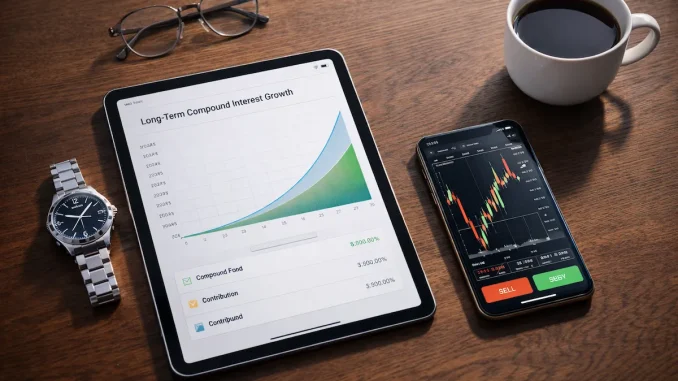
Long-term investing, often defined as a horizon of five years or more, is built on the power of Compounding and Economic Growth. In this model, you are not betting on price movements; you are participating in the value creation of businesses and economies over time.
💡 The “Time In the Market” Advantage:
Historical data shows that the probability of losing money in the stock market drops significantly the longer you hold. For a 20-year period, the S&P 500 has never produced a negative real return, regardless of the entry point.
Long-term strategies typically utilize “Buy and Hold” or “Value Investing” methodologies. By ignoring daily market noise, investors reduce transaction costs and benefit from lower long-term capital gains tax rates—a crucial factor in maintaining your financial stability.
The Mechanics of Short-Term Investing
Short-term investing, or trading, focuses on capturing price movements within days, weeks, or months. This strategy relies on Technical Analysis, market sentiment, and immediate catalysts like earnings reports or geopolitical shifts.
⚠️ Warning: The Volatility Tax
Short-term trading requires intense monitoring and quick decision-making. In 2026’s volatile landscape, the hidden costs—including higher brokerage fees and short-term taxes—can eat up to 40% of your gross profits if not managed carefully.
[Image: A realistic photo of a professional investor’s dual-monitor setup showing a complex candlestick chart on one screen and a news terminal on the other.]
Comparative Analysis: Strategy vs. Objective
Choosing between these two paths isn’t about which is “better,” but which is appropriate for your specific objective. The table below highlights how these strategies diverge in practice:
| Feature | Long-Term Strategy | Short-Term Strategy |
|---|---|---|
| Primary Driver | Fundamental Value | Price Volatility |
| Risk Profile | Market Risk (Systemic) | Timing Risk (Specific) |
| Time Commitment | Low (Quarterly reviews) | High (Daily monitoring) |
| Ideal Assets | Index Funds, Blue Chips, Real Estate | Options, Forex, Growth Stocks |
| Impact of Inflation | Easier to outpace via growth | Harder to manage due to timing |
The Hybrid Approach: Core and Satellite
Many sophisticated investors in 2026 use a Core and Satellite model. They place 80% of their capital in long-term, low-cost index funds (The Core) to ensure steady growth. The remaining 20% (The Satellite) is used for short-term tactical trades to capitalize on specific market opportunities. This balances the safety of the long term with the potential alpha of the short term.
Final Thoughts: Aligning Your Clock with Your Capital
Ultimately, your investment horizon should match your life goals. If you are saving for a house next year, the stock market’s volatility is your enemy. If you are saving for retirement in 20 years, that same volatility is your opportunity to buy more shares at a discount. Understanding where you sit on this timeline is the first step toward investment mastery.
As we continue our exploration of investment strategies, the next variable we must address is your personal appetite for uncertainty. Join us in our next article as we examine how risk tolerance shapes investment strategies to find your perfect balance.
Frequently Asked Questions (FAQ)
Can I turn a short-term trade into a long-term investment?
Be careful. This is often called “hope-vesting.” It happens when a short-term trade goes wrong, and the investor decides to hold it forever to avoid realizing a loss. A true long-term investment should be based on strong fundamentals, not as a reaction to a bad trade.
How does 2026 inflation affect my time horizon?
Inflation generally favors long-term investing in “real assets” like equities and property. In the short term, inflation causes interest rate spikes which can be devastating for traders holding leveraged positions or high-growth tech stocks that are sensitive to rate changes.
Is long-term investing still viable in a fast-moving AI economy?
Yes, more than ever. While AI speeds up information processing, the time it takes for a company to build infrastructure, grow its customer base, and generate real profits hasn’t changed. Long-term investing allows you to profit from the actual utility of AI rather than just its hype.


Be the first to comment