
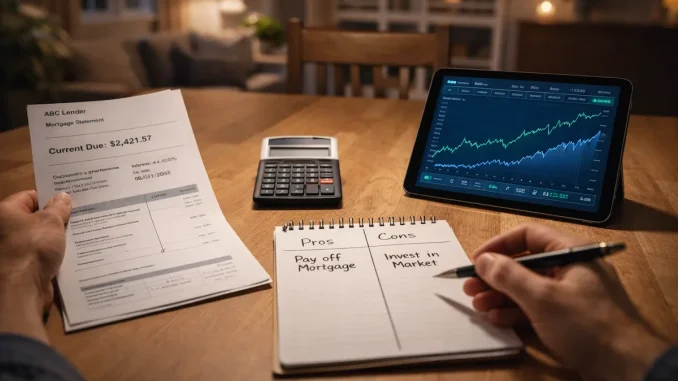
It is the ultimate financial debate of the decade: Do you strive for the peace of mind of a debt-free home, or do you leverage your cheap debt to build greater wealth in the market? In 2026, the answer is no longer black and white.
Many homeowners are currently holding “Golden Handcuffs”—mortgages secured years ago at historically low rates (2-4%). Meanwhile, current savings accounts and investment vehicles are offering returns of 5% or more. On paper, the math seems simple. But personal finance is rarely just about math; it is about risk, liquidity, and how well you sleep at night.
Building on our guide to financial stability, this article dissects the “Pay Off vs. Invest” dilemma. We will analyze the concept of negative arbitrage, the hidden dangers of illiquid home equity, and why inflation might actually be your best friend if you hold debt.
The Math: Understanding Positive Arbitrage
From a purely mathematical standpoint, the decision comes down to a simple comparison: Cost of Debt vs. Rate of Return.
If your mortgage interest rate is fixed at 3.5% and a risk-free High-Yield Savings Account (HYSA) pays 5.0%, you earn a “spread” of 1.5% simply by keeping the money in the bank. Paying off the mortgage early in this scenario is mathematically equivalent to losing money.
📊 The Compound Effect:
By investing the surplus instead of paying down cheap debt, you allow your capital to compound. Over 20 years, this difference can amount to hundreds of thousands of dollars in extra net worth, thanks to the power of market growth outacing interest costs.
The Liquidity Trap: Cash vs. Equity
One of the biggest risks of aggressive mortgage repayment is Illiquidity. When you send an extra $10,000 to your mortgage lender, that money transforms from “Cash” to “Home Equity.”
- Cash can be used to buy groceries, fix a car, or invest in a new opportunity.
- Equity is trapped in the walls of your house. To access it, you must sell the house or qualify for a loan (which might be impossible if you have lost your job).
In an uncertain economy, maintaining liquidity is often safer than being debt-free but cash-poor.
The Inflation Hedge Argument
Inflation erodes the value of currency. If you have a fixed-rate mortgage, inflation is actually working in your favor. You borrowed “expensive” dollars years ago, but you are paying them back with “cheaper” inflated dollars today. Pre-paying a mortgage destroys this natural hedge against inflation.
| Factor | Paying Off Mortgage 🏠 | Investing Surplus 📈 |
|---|---|---|
| Return on Capital | Guaranteed (Equal to interest rate) | Variable (Potentially higher) |
| Risk Level | Zero Risk | Market Risk |
| Liquidity | Low (Trapped equity) | High (Stocks/Bonds/Cash) |
| Psychological Benefit | High (Total freedom) | Moderate (Watching wealth grow) |
The Psychological Factor: The “Sleep Test”
Despite the math, debt carries an emotional weight. For many, the feeling of owning their home “free and clear” is worth more than a 2% arbitrage spread. If debt causes you anxiety that affects your health or relationships, the mathematical “loss” of paying it off is a fair price for peace of mind.
Final Thoughts: It’s Personal, Not Just Financial
The “right” answer depends on your unique goals. If you are young and focused on wealth accumulation, leveraging low-interest debt is a powerful tool. If you are approaching retirement and value security over growth, eliminating monthly payments may be the superior choice.
Often, the best path is a compromise. Next, we will explore a scenario where plans go wrong: how to recover financially from a ‘Gray Divorce’ after age 50.
Frequently Asked Questions (FAQ)
Does paying off my mortgage hurt my credit score?
Slightly, yes. When you close a mortgage account, your “Credit Mix” diversity decreases, and the account moves from “active” to “closed.” However, the drop is usually minor and temporary. Don’t keep a loan just for the credit score.
What is “Mortgage Recasting” vs. Refinancing?
Refinancing replaces your old loan with a new one (often at a higher rate today). Recasting allows you to pay a lump sum to reduce the principal and lower monthly payments without changing your interest rate or loan term. This is a great middle-ground option.
Can I invest the money now and pay off the house later?
Yes. This is called a “Sinking Fund” strategy. You invest the extra payments into a brokerage account. Once that account balance equals your mortgage balance, you have the option to write a check and pay it off instantly, maintaining liquidity until that day comes.




Be the first to comment