
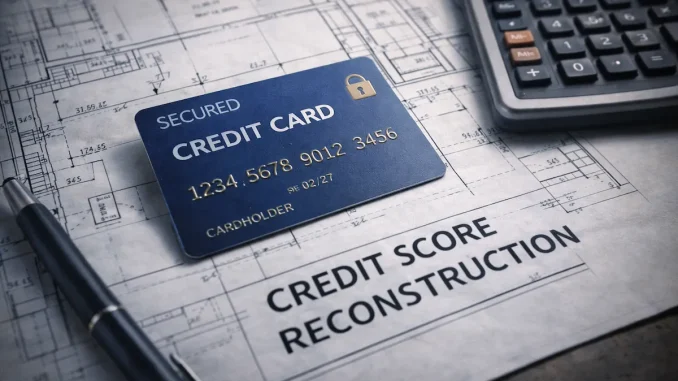
It is the classic “Chicken and Egg” problem of finance: You need a credit card to build a credit score, but you need a good credit score to get a credit card. If you have made mistakes in the past, traditional banks lock the door.
Enter the Secured Credit Card. It is not just a plastic rectangle; it is the most powerful tool available for credit repair in 2026. However, most people use it wrong. They treat it like a debit card or, worse, max it out immediately, defeating its purpose.
In this strategic guide, part of our advanced banking series, we stop treating secured cards as a penalty box and start using them as a stepping stone. We will cover the deposit mechanics, the “Utilization Ratio” hack, and the exact timeline to request your “graduation” to an unsecured card.
The Mechanism: Deposit = Limit
Unlike a regular (unsecured) card where the bank trusts you, a secured card runs on collateral. You deposit $200, $500, or $1,000 upfront. This deposit becomes your credit limit.
Myth Buster: Many people think, “If I’m using my own money, isn’t it just a debit card?”
The Reality: No. A debit card does not report to credit bureaus. A secured card reports your payment history to Equifax, Experian, and TransUnion every month. You are essentially paying a deposit to buy a data stream that proves your trustworthiness.
The Strategy: The “10% Rule” for Maximum Growth
The goal is not to spend; the goal is to generate a “Paid as Agreed” status on your report. To boost your score fastest, follow this protocol:
📈 The Micro-Payment Strategy:
1. Put one small, recurring subscription on the card (e.g., Netflix for $15).2. Set up “Auto-Pay” to pay the full balance 3 days before the due date.
3. Lock the card away.
This keeps your “Credit Utilization” extremely low (under 10%), which accounts for 30% of your FICO score. High utilization on a low-limit card (e.g., spending $190 on a $200 limit) will actually hurt your score.
The Exit Plan: Graduation Day
A secured card is a temporary bridge, not a permanent destination. You don’t want your $500 deposit locked up forever.
- Month 1-6: Execute the Micro-Payment Strategy perfectly. Zero late payments.
- Month 7: Call your issuer. Ask specifically: “Is my account eligible to graduate to an unsecured card?”
- The Result: Many major issuers (like Discover or Capital One) will review your account automatically. If you pass, they refund your deposit via check and convert your card to a standard credit card, often increasing your limit simultaneously.
| Card Type | Reports to Bureaus? 📊 | Deposit Required? 💰 |
|---|---|---|
| Secured Card | YES (Builds Credit) | Yes (Refundable) |
| Prepaid Debit | NO (Does Nothing) | Yes (Usage fees) |
| Unsecured Card | YES (Maintains Credit) | No |
| Purpose | Repair / Rebuild | Spending Control |
Final Thoughts: Patience Pays Dividends
Rebuilding credit is boring, slow work, but a Secured Card is the fastest shortcut available. By treating this card as a reputation-building tool rather than a spending wallet, you can often boost your score by 50-100 points within a year. Once you graduate, you enter the world of rewards, cash back, and lower interest rates.
Sometimes, however, you can’t even open a secured card because you can’t open a bank account. Next, we tackle a hidden banking blacklist in the ChexSystems survival guide: how to open a bank account if you are ‘blacklisted’.
Frequently Asked Questions (FAQ)
Can I be denied for a Secured Card?
Yes. Even though you provide the money, the bank still checks your history. If you have a recent bankruptcy or an active delinquency, they may deny you. In that case, look for “No Credit Check” secured cards.
Does closing a Secured Card hurt my score?
It can. Closing an account reduces your “Average Age of Accounts.” That is why “Graduation” (converting it to unsecured) is better than closing it. You keep the history and get your deposit back.
How much deposit should I put down?
Usually, the minimum is around $200. Putting down more ($500 or $1,000) creates a higher credit limit. A higher limit makes it easier to keep your utilization percentage low, which is better for your score.


Be the first to comment