
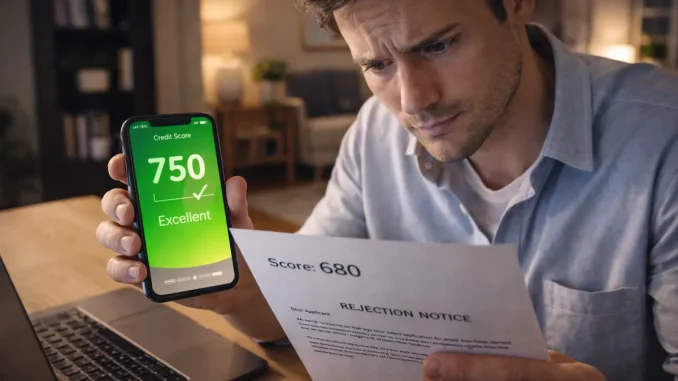
It is a scenario that plays out in loan offices every day: You check your credit app, beam with pride at your “Excellent” score, and walk into the bank—only to be told your “actual” score is 40 points lower and your loan is denied.
This discrepancy is not a glitch, nor is it a scam. It is the result of a complex, proprietary data ecosystem that most consumers are never taught. While free apps like Credit Karma provide a valuable service, they often show you a different “version” of your financial reputation than the one lenders use to assess risk.
Building on our foundational guide to understanding credit scores, this advanced article peels back the curtain on the “Score Wars.” We will explain the critical difference between FICO and VantageScore, reveal the specific “older” models mortgage lenders still use, and help you find your “real” transaction score.
Why is Credit Karma’s Credit Score Different?
If you’ve noticed that your credit score on Credit Karma is different from the one your bank or mortgage lender shows you, you’re not alone. The main reason for this discrepancy is that Credit Karma uses the VantageScore 3.0 model, while most lenders (over 90%) rely on FICO scores. Both are accurate, but they calculate your creditworthiness using different algorithms.
Key Reasons for the Score Difference:
- Different Scoring Models: Credit Karma uses VantageScore 3.0, which weighs factors like “available credit” and “recent credit” differently than FICO.
- Credit Bureau Data: Credit Karma pulls data from TransUnion and Equifax. If your lender pulls from Experian, any missing or different data will result in a different score.
- Update Frequency: Credit Karma often updates weekly, whereas other platforms or lenders may only update once a month, causing a “time-lag” in the numbers.
- Industry-Specific Versions: Lenders often use specific FICO versions for auto loans or mortgages, which are not the general scores shown on free apps.
| Feature | Credit Karma | Most Lenders |
|---|---|---|
| Scoring Model | VantageScore 3.0 | FICO (Various versions) |
| Bureaus Used | TransUnion & Equifax | Often all three (incl. Experian) |
| Purpose | Educational tracking | Lending decisions |
Expert Verdict: Neither score is “wrong.” Credit Karma provides a highly accurate look at your credit health, but your FICO score is what lenders will ultimately use to approve your loan or set your interest rate.
Updated: February 2026 | Financial Literacy Series
The Core Conflict: VantageScore vs. FICO
The primary reason for the discrepancy is that you and the lender are speaking different languages.
- Educational Scores (You see): Most free apps (Credit Karma, Chase Journey, etc.) use the VantageScore 3.0 or 4.0 model. This model was created by the credit bureaus to compete with FICO. It is highly reactive to recent changes and often generates a higher score for consumers with thin credit files.
- Lending Scores (Banks see): 90% of top lenders use FICO scores. FICO algorithms weigh debt history and payment longevity differently than VantageScore.
⚠️ The “Inflation” Effect:
VantageScore tends to be more generous. It often ignores paid collections and weighs utilization less heavily than older FICO models. This creates a “Score Inflation” where a consumer feels safer than they actually are in the eyes of a bank.
The “Version” Trap: Why Mortgage Lenders Live in the Past
Even if you access your FICO score, you might be looking at FICO 8 or FICO 9 (the modern versions used for credit cards). However, when you apply for a Mortgage, lenders are legally required by Fannie Mae and Freddie Mac to use much older versions.
These “Classic FICO” versions are stricter. They penalize medical collections and authorized user accounts more heavily than modern versions. This is why your mortgage score is almost always lower than your credit card score.
| Loan Type | Score Model Used 🏦 | Key Characteristic |
|---|---|---|
| Mortgage | FICO 2, 4, or 5 | Very strict; older algorithms; sensitive to paid collections. |
| Auto Loan | FICO Auto Score 8 | Weighted heavily on past car payments. |
| Credit Card | FICO 8 / FICO 9 | Forgiving of small medical debts; rewards low utilization. |
| Free App | VantageScore 3.0 | Educational only. Rarely used for decisions. |
The Timing Lag: Statement Dates vs. Real-Time
Another common culprit is timing. Credit report data is not real-time. Creditors typically report your balance to bureaus once a month, usually on your statement closing date.
If you pay off your credit card in full on the 15th, but the statement closed on the 14th with a high balance, the lender pulling your report on the 16th will see maxed-out credit, even though you have zero debt. This “Utilization Lag” can temporarily drop your score by 20-50 points.
💡 Pro Strategy: The “AZEO” Method
To maximize your score before a major loan application, use the “All Zero Except One” (AZEO) method. Pay off all credit card balances to $0 before the statement date, leaving just one card with a tiny balance (e.g., $10). This forces the FICO algorithm to see optimized utilization.
Final Thoughts: Use the Right Tool for the Job
Think of Credit Karma and other free apps as a “Check Engine Light”—they are great for alerting you to major changes or errors on your report. However, they are not a precise speedometer. When preparing for a major financial event like buying a home, rely only on FICO scores, which can often be purchased directly from the bureaus or accessed via premium banking services.
Now that you understand the scoring landscape, we turn to another major banking hurdle in the remote-work era: can I maintain my UK/US bank account legally while living permanently abroad as a digital nomad?
Frequently Asked Questions (FAQ)
Can I ask the lender to use my Credit Karma score?
No. Lenders have strict underwriting contracts and regulatory requirements that dictate exactly which score model they must use. They cannot swap models just because one is higher.
Is it worth paying for my FICO score?
If you are about to apply for a mortgage, absolutely yes. Paying for a one-time “3-Bureau Report” from myFICO.com gives you the exact FICO 2, 4, and 5 scores that mortgage lenders see, eliminating surprises.
Why do I have three different scores from three bureaus?
Each bureau (Experian, Equifax, TransUnion) collects data independently. Not all lenders report to all three. One might have an old late payment that the others don’t, causing that specific bureau’s score to be significantly lower.




Be the first to comment