
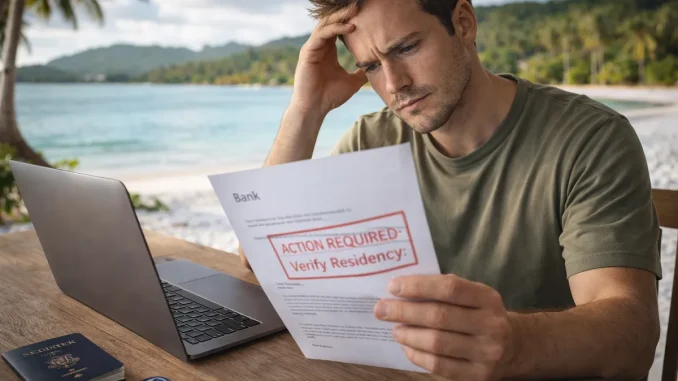
The digital nomad dream is freedom: working from a beach in Bali or a cafe in Lisbon. The digital nomad nightmare is logging in to check your balance and seeing the message: “Account Frozen. Please contact a branch immediately.”
For US and UK citizens living permanently abroad, maintaining a home bank account is a gray area filled with compliance minefields. While it is rarely illegal to hold an account while abroad, it frequently violates the bank’s internal “Terms of Service.” Banks are risk-averse, and a customer who logs in from twelve different countries in a year looks suspiciously like a money launderer to their algorithms.
Building on our previous analysis of credit reporting discrepancies, this guide tackles the logistical challenge of cross-border banking. We will explain the difference between a “mailing address” and a “residential address,” the risks of using virtual mailboxes, and the tiered banking strategy you need to survive.
The Core Problem: KYC and “De-Risking”
Banks are under immense pressure from regulators to Know Your Customer (KYC). If you live in a high-risk jurisdiction or simply don’t have a verifiable permanent address in your home country, you become a liability.
Most standard checking accounts in the US and UK are contractually limited to residents. If the bank discovers you have moved permanently (usually defined as being away for more than 6 months), they reserve the right to close your account with 30 days’ notice to “de-risk” their portfolio.
The Address Dilemma: Virtual vs. Residential
Many nomads try to solve this by using a Commercial Mail Receiving Agency (CMRA) or a “Virtual Mailbox.” In 2026, this strategy is failing.
⚠️ The CMRA Flag:
US and UK banking systems now automatically cross-reference addresses against national databases. If your address is flagged as a commercial facility (CMRA), your account may be restricted until you provide a utility bill proving you physically live there.
The Safe Harbor Strategy: The most reliable method is to use the address of a trusted family member (parents or siblings). You must legally change your address to their home and, ideally, have at least one official document (like a driver’s license or voter registration) linked to that address.
The “Nomad Banking Stack” Strategy
To avoid being stranded without funds, you must diversify your banking partners. Relying on a single “High Street” bank (like Chase or Barclays) is dangerous. Successful nomads use a three-tiered stack:
| Tier | Purpose | Example Institutions |
|---|---|---|
| 1. The Vault | Long-term savings/investments. Keep quiet here. | Charles Schwab, Fidelity, Vanguard |
| 2. The Hub | Receiving salary & transfers. Nomad-friendly. | Wise, Revolut, Monzo (UK), Mercury (US Business) |
| 3. The Local | Cash withdrawals & rent. Low fees. | Local bank in your host country (e.g., Bangkok Bank) |
The Impact of FATCA (US) and CRS (UK/Global)
Never confuse “banking privacy” with “tax evasion.” Under FATCA (for Americans) and CRS (Common Reporting Standard for everyone else), foreign banks share your account data with your home country’s tax authority.
If you open a local bank account in Spain or Thailand, that bank will report your balance to the IRS or HMRC. Therefore, maintaining a compliant tax status at home is the best way to ensure your banking relationships remain stable.
💡 Pro-Tip: Use a Dedicated VPN
When logging into your Tier 1 (Vault) accounts, always use a VPN with a dedicated IP address from your home country. Frequent logins from “high-risk” IP addresses (like public airport Wi-Fi in obscure locations) trigger automated fraud freezes faster than anything else.
Final Thoughts: Redundancy is Key
Maintaining a US or UK bank account while living abroad is a game of risk management. It requires a permanent physical address back home, a robust “Tech Stack” of fintech alternatives, and the discipline to never keep all your liquidity in one institution. If one door closes, you must have two others already open.
Managing your accounts is one thing; managing your credit score while shopping for a home is another. Next, we debunk a common myth in does shopping for mortgage rates within a 14-day window really protect my credit score?
Frequently Asked Questions (FAQ)
Is it illegal to use my parents’ address for my bank?
It is generally not illegal if you consider it your permanent “domicile” and can receive mail there. However, it may violate the bank’s policy if you don’t actually sleep there. It is a common “gray area” practice for expats, but ensure your family consents to handling your sensitive mail.
What happens if my bank closes my account while I’m abroad?
They will typically issue a cashier’s check for the remaining balance and mail it to the address on file. This is a disaster if you are in Bali and the check goes to New York. This is why having a secondary “Hub” account (like Wise) is non-negotiable.
Can I just use a specialized “Expat Account”?
Yes. Banks like HSBC Expat or Standard Bank Isle of Man offer accounts specifically designed for non-residents. They require higher minimum deposits (often £50k+) but are fully compliant and won’t close just because you moved countries.



Be the first to comment