
Most investors believe they are diversified because they own ten different stocks. But if those ten stocks are all large-cap tech companies, they aren’t diversified—they are overexposed to a single “style.”
In 2026, market volatility has made it clear that picking the right sector is only half the battle. You must also pick the right style. Professional fund managers use the Morningstar Style Box to visualize and balance their portfolios, ensuring they aren’t caught off guard when the market rotates from high-flying growth stocks back to boring, reliable value companies.
Following our analysis of lump sum vs. DCA math, this guide introduces the Style Box framework. We will define the difference between “Growth” and “Value,” explain the 3×3 grid, and show you how to build a resilient portfolio for the 2026 economic landscape.
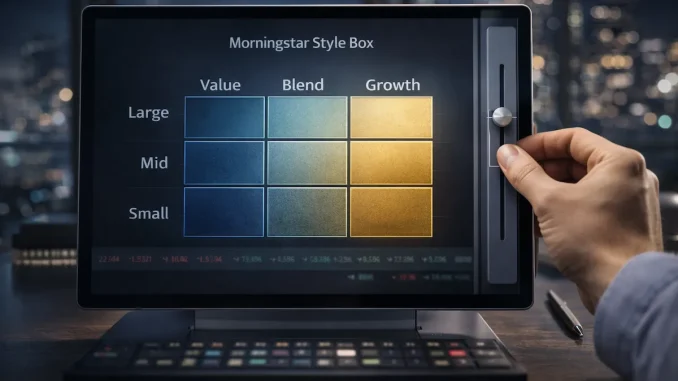
The 3×3 Matrix: Decoding the Style Box
The Style Box is a visual representation of an investment’s characteristics. It uses two axes to categorize stocks:
- Vertical Axis (Size): Categorizes companies by market capitalization into Large, Mid, or Small caps.
- Horizontal Axis (Style): Categorizes stocks by their valuation and growth prospects into Value, Blend, or Growth.
By placing your investments into these nine boxes, you can instantly see where your “holes” are. If all your assets are in the “Large-Cap Growth” box (think Apple, Nvidia, Microsoft), you are vulnerable to interest rate hikes that typically punish high-valuation stocks.
Growth vs. Value: The 2026 Debate
Understanding the DNA of these two styles is critical for survival in the current market.
1. Growth Stocks (The Dreamers)
These companies are expected to grow sales and earnings faster than the market average. They usually don’t pay dividends because they reinvest every dollar into expansion.
Key Metric: High Price-to-Earnings ($P/E$) ratio.
Performance: They dominate during low-interest-rate environments and economic expansions.
2. Value Stocks (The Bargains)
These are “undervalued” companies that trade for less than their intrinsic worth. They are often mature companies with stable cash flows and steady dividends.
Key Metric: Low Price-to-Book ($P/B$) or high Dividend Yield.
Performance: They act as defensive shields during market downturns and high-inflation periods.
💡 The “Blend” Strategy:
If you can’t decide, “Blend” funds (also called Core) offer a mix of both. This is a common starting point for investors using the dividend snowball method, as many Aristocrats sit comfortably in the Large-Cap Value or Blend squares.
| Feature | Growth Stocks 📈 | Value Stocks 🛡️ |
|---|---|---|
| Valuation | Expensive (High $P/E$) | Cheap (Low $P/E$) |
| Dividends | Rare / Low | Common / High |
| Volatility | High | Moderate to Low |
| Economic Cycle | Early to Mid-Cycle | Late Cycle / Recession |
Final Thoughts: Don’t Put All Your Eggs in One Box
The goal of the Style Box strategy isn’t to find the “best” box; it’s to ensure you aren’t accidentally concentrated in just one. For a resilient 2026 portfolio, consider a “Core and Satellite” approach: keep your core in Large-Cap Blend/Value for stability, and use Small-Cap Growth as a satellite for potential explosive returns. Balance is the ultimate hedge against uncertainty.
Once you’ve mastered the styles of individual stocks, you might want a simpler, “set-it-and-forget-it” approach to total portfolio management. Next, we analyze target date funds: are they too conservative for young investors?
Frequently Asked Questions (FAQ)
Can a stock move between boxes?
Yes. This is called “Style Drift.” A fast-growing Small-Cap company can become a Large-Cap Growth giant (like Amazon did). Conversely, a fallen Growth star whose price drops significantly might end up in the Value box. This is why you must rebalance annually.
Which box has the highest historical returns?
Historically, Small-Cap Value has actually outperformed almost every other box over very long periods (decades). However, it comes with much higher volatility and requires a very strong stomach to hold during market crashes.
How do I find the style of my ETF?
Most major finance sites (like Yahoo Finance or Morningstar) have a “Portfolio” or “Risk” tab for every ETF. It will show you exactly which boxes the fund occupies, allowing you to see if your various ETFs are overlapping too much.




Be the first to comment