
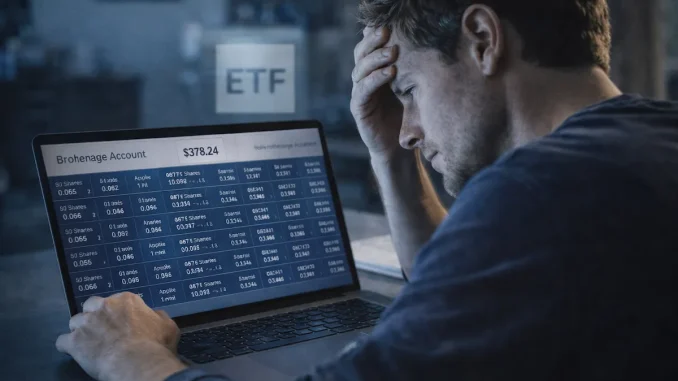
For decades, “Direct Indexing” was a strategy reserved for the ultra-wealthy with portfolios over $5 million. In 2026, fintech apps have democratized it, offering the same tools to investors with as little as $5,000. But just because you can do it, doesn’t mean you should.
Direct Indexing involves buying the individual components of an index (like all 500 stocks in the S&P 500) rather than a single ETF. The pitch is seductive: “Harvest tax losses on individual losers while keeping the winners.” However, for retail investors with portfolios under $100,000, the math often breaks down.
Completing our advanced series on tax strategies and generational wealth, this guide exposes the hidden friction of Direct Indexing. We will analyze “Tracking Error,” the nightmare of portability, and why a simple low-cost ETF is likely still the superior choice for the 99%.
The Myth of “Optimization”: Tracking Error
To perfectly replicate the S&P 500, you need to buy 500 stocks in exact market-cap weights. With a $50,000 portfolio, this is mathematically difficult, even with fractional shares. Some stocks trade at prices that make precise weighting impossible without creating “dust” (untradable tiny amounts).
Instead, automated platforms use “Sampling.” They might buy only 150 stocks that “represent” the index. The risk? Tracking Error. If the algorithm excludes a specific sector or stock that suddenly rallies (like a surprise tech boom), your “Direct Index” will significantly underperform the actual benchmark ETF (like VOO or SPY) you were trying to beat.
The “Roach Motel” Problem: Portability
The biggest hidden risk is Exit Complexity.
- With an ETF: If you want to switch brokers (e.g., from Betterment to Fidelity), you transfer one ticker symbol. Simple.
- With Direct Indexing: You own 300+ individual tax lots. If you want to leave the platform, you have to transfer 300 separate stocks. Many brokers charge fees per position for transfers, or the new broker may not support the fractional shares, forcing a liquidation.
This creates a “Roach Motel” effect: You can check in easily, but checking out triggers a massive tax event or administrative nightmare.
⚠️ The Fee Drag:
Direct Indexing services typically charge a fee of 0.25% to 0.40%. A standard S&P 500 ETF charges 0.03%.To break even, your tax-loss harvesting must generate more than 0.37% in net alpha every single year. For a <$100k portfolio in a bull market (where stocks mostly go up), finding enough losses to harvest to justify the fee is often mathematically impossible.
Complexity vs. Benefit
For a high-net-worth investor in a 37% tax bracket, saving 1% on taxes is worth thousands. For a retail investor in a 22% or 24% bracket with a $50,000 portfolio, the tax savings might be $200—which is likely consumed by the platform fees and the “cash drag” (money left uninvested).
| Feature | Standard ETF (VOO/IVV) | Direct Indexing (<$100k) |
|---|---|---|
| Annual Fee | ~0.03% | 0.25% – 0.40% + |
| Tax Reporting | 1 Form (1099-B) | Hundreds of lines on 1099-B |
| Rebalancing | Automatic (Internal) | Frequent Taxable Events |
| Ideal Portfolio | $500 – $1M+ | $250k – $5M+ |
Final Thoughts: Don’t Use a Sledgehammer to Crack a Nut
Direct Indexing is a powerful tool, but it is a tool designed for specific tax situations involving large capital gains. For a retail investor with under $100k, the complexity, higher fees, and tracking error risks usually outweigh the marginal tax benefits.
Simplicity is an asset class of its own. Sticking to low-cost, broad-market ETFs allows you to capture market returns without the headache of managing hundreds of ticker symbols. This concludes our advanced Investing Strategies series. Next, we will explore the cutting edge of finance in our Fintech & Future pro series.
Frequently Asked Questions (FAQ)
What is the minimum amount needed for Direct Indexing to make sense?
Most financial planners suggest a minimum of $250,000 to $500,000 in taxable accounts. At this level, the tax benefits (harvesting losses to offset other gains) are large enough to cover the higher management fees.
Can I do Direct Indexing manually to save fees?
Theoretically yes, practically no. Trying to buy and rebalance 500 stocks manually to match the S&P 500 is a full-time job. You will likely suffer from massive tracking error and wash sale violations. It is not recommended.
Does Direct Indexing beat the market?
No. The goal is to match the market pre-tax, and beat the market after-tax. It is not an alpha-generating strategy; it is a tax-efficiency strategy.


Be the first to comment