
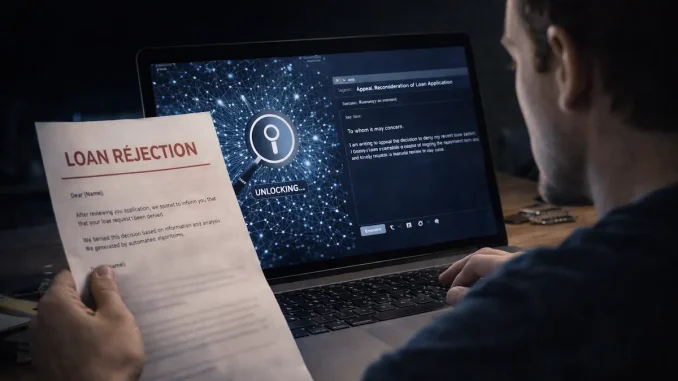
“We are sorry, but our automated system has declined your application.” In the past, you could argue your case with a bank manager. Today, you are often arguing with a mathematical model that even its creators don’t fully understand.
As Artificial Intelligence takes over credit underwriting, the risk of “Algorithmic Bias” has skyrocketed. An AI might deny a loan because of your zip code, your shopping habits, or even the type of phone you use. But in 2026, the law has finally caught up.
Concluding our Fintech & Future series, this final guide empowers you to fight back. We will explain the new “Right to Explanation” laws in the US and EU, how to decipher an “Adverse Action Notice,” and the specific steps to appeal a robot’s rejection.
The “Black Box” vs. The Law
The core problem with modern AI (Deep Learning) is that it is a “Black Box.” It finds patterns that humans cannot see. However, financial regulations like the EU AI Act and the US CFPB Circulars now mandate “Explainability.”
The Rule: A lender cannot simply say “You didn’t score high enough.” They must provide the Specific Principal Reasons for the denial. If the AI used “alternative data” (like your social media presence or utility bills) to make that decision, they must disclose it.
Step 1: Decode the “Adverse Action Notice”
When you are denied, you receive a legal document called an Adverse Action Notice. In the age of AI, look for vague codes.
- Old Reason: “High Debt-to-Income Ratio” (Clear).
- AI Reason: “Insufficient non-traditional credit references” or “Behavioral risk factors.” (Vague).
If the reason is vague, you have the right to request a “Specific Explanation” within 60 days. This forces the lender to ask their AI vendor why the decision was made.
Step 2: The “Human in the Loop” Appeal
Under GDPR (Article 22) in Europe and emerging laws in US states, you have the right not to be subject to a decision based solely on automated processing.
⚖️ Your Superpower:
You can formally request a “Human Review.” This compels a human underwriter to look at your file manually. If the AI denied you because of a statistical anomaly (e.g., you are a freelancer with irregular but high income), a human can override the algorithm.
Step 3: Check for “Input Data” Errors
AI is only as good as the data it is fed. If the AI scraped “Open Banking” data and saw a large transfer to a gambling site (which was actually you paying back a friend for dinner), it might flag you as high risk.
Action: Demand to know what data sources were used. If they used third-party data brokers (like LexisNexis or Plaid), you have the right to dispute incorrect information in those files, just like a standard credit report.
| Region | Regulation | Key Right 🛡️ |
|---|---|---|
| European Union / UK | GDPR / EU AI Act | Right to Human Intervention & Explanation. |
| United States | ECOA / CFPB Rules | Right to Specific Principal Reasons (No “Black Box” excuse). |
| Global / Fintech | Terms of Service | Often limited (Must rely on local laws). |
Final Thoughts: The Algorithm is Not Absolute
Technology has made credit faster, but not infallible. As we conclude our comprehensive guide to the financial world, remember this: You are more than a data point. The law recognizes your humanity, even if the software does not. By knowing your rights to explanation and appeal, you can ensure that the future of finance remains fair, transparent, and accessible to all.
Thank you for joining us on this journey through Global Markets, Banking, Personal Finance, Investing, and the Future of Fintech. Stay curious, stay educated, and keep building your wealth.
Frequently Asked Questions (FAQ)
Can I sue a bank if their AI discriminates against me?
Potentially, yes. Under the Equal Credit Opportunity Act (ECOA) in the US, if an AI model unintentionally discriminates against a protected class (race, gender, age)—known as “Disparate Impact”—the lender is liable. Regulators are actively punishing banks for biased algorithms.
What is “Explainable AI” (XAI)?
XAI is a set of processes and methods that allows human users to comprehend and trust the results created by machine learning algorithms. It is the opposite of the “Black Box” concept.
Does requesting a manual review hurt my credit score?
No. A manual review is simply a reconsideration of an existing application. It does not trigger a new “Hard Inquiry” on your credit report.


Be the first to comment