
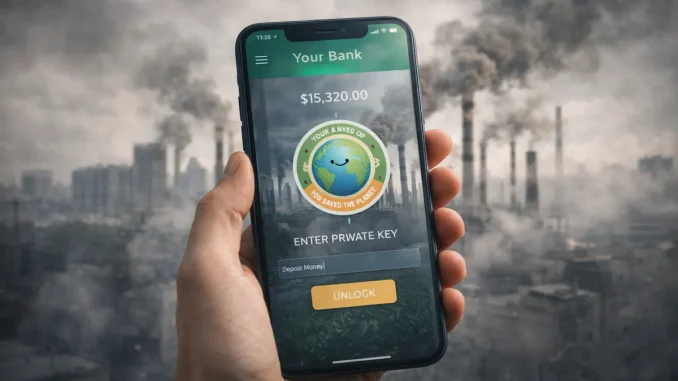
In 2026, every fintech app wants to be your eco-friendly best friend. They offer “carbon footprint tracking,” promise to plant trees for every transaction, and sell “sustainable” ETFs. But how much of this is real impact, and how much is just a fresh coat of green paint?
Greenwashing is the practice of conveying a false impression or providing misleading information about how a company’s products are more environmentally sound. In the financial sector, where money is abstract, it is incredibly easy to hide “dirty” investments behind “clean” marketing.
Following our guide on protecting digital assets, we now turn to protecting your values. This article exposes the most common sustainability gimmicks in Fintech, teaches you how to audit an “ESG” portfolio, and reveals the red flags that suggest an app is more interested in your conscience than the climate.
The “Plant a Tree” Gimmick
The most pervasive form of greenwashing is the promise to plant a tree for every purchase or “round-up.” While trees are vital, this model is often performative.
- The Reality: Many of these programs plant monoculture saplings in areas where they may not survive or where they displace local biodiversity.
- The Audit: Does the app publish GPS coordinates of the planting sites? Do they work with verified partners (like Eden Reforestation Projects) or obscure third parties? If there is no transparency report, it is likely marketing fluff.
The “ESG Fund” Trap
Many Robo-advisors offer “Socially Responsible” or “ESG” (Environmental, Social, Governance) portfolios. Users assume these exclude oil and gas companies. They are often wrong.
In 2026, many ESG funds simply replicate the S&P 500 but exclude the absolute worst offenders (like tobacco), while still holding massive positions in oil majors that have “pledged” to go green by 2050. This is “Best-in-Class” screening, not true exclusion.
🔍 How to Check:
Don’t trust the fund name. Look at the “Top 10 Holdings.” If you see ExxonMobil, Chevron, or a massive coal utility in a “Green Future” ETF, you are being greenwashed.
Carbon Offsets vs. Carbon Removal
Fintech apps often claim to make your spending “Carbon Neutral” by buying offsets.
- Offsets (Cheap): Paying someone else not to emit carbon (e.g., protecting a forest that wasn’t in danger). Often riddled with fraud.
- Removal (Expensive): Actually taking CO2 out of the atmosphere (e.g., Direct Air Capture).
If an app claims to offset your entire life for $5 a month, they are buying low-quality “junk” offsets that do little for the planet.
| Feature | Greenwashing (Red Flag) 🚩 | True Sustainability (Green Flag) ✅ |
|---|---|---|
| Credit Cards | “Made of recycled plastic” (but encourages overconsumption) | Caps emissions / Donates revenue to climate action |
| Investments | “ESG” label with oil stocks | “Fossil Fuel Free” mandate / Impact Investing |
| Bank Money | Lends deposits to pipelines | Certified B-Corp / GABV Member |
| Transparency | Vague “Green Goals” | Annual Impact Report with audited data |
Final Thoughts: Follow the Money, Not the Marketing
True sustainability in finance isn’t about the color of your debit card; it is about where your deposit sits at night. A bank that uses your money to fund renewable energy projects does more for the planet than an app that plants a tree but lends your savings to a coal plant.
Be skeptical, demand data, and look for third-party certifications like B-Corp.
Frequently Asked Questions (FAQ)
What is a B-Corp Bank?
A Certified B Corporation is a company legally required to balance profit and purpose. B-Corp banks (like Amalgamated Bank or Triodos) are audited to ensure their money does not fund harmful industries. This is the gold standard for avoiding greenwashing.
Is Bitcoin bad for the environment?
It’s complicated. Bitcoin mining consumes massive amounts of energy. However, over 50% of mining now uses renewable energy. Still, “Green” Fintech apps often avoid Bitcoin due to its carbon footprint, preferring “Proof of Stake” chains like Ethereum.
Can I trust “Net Zero” pledges?
Treat “Net Zero by 2050” with extreme skepticism. That is a promise for 24 years from now. Look for “Interim Targets” (e.g., 50% reduction by 2030). If a bank has no short-term targets, their long-term pledge is likely just PR.




Be the first to comment