
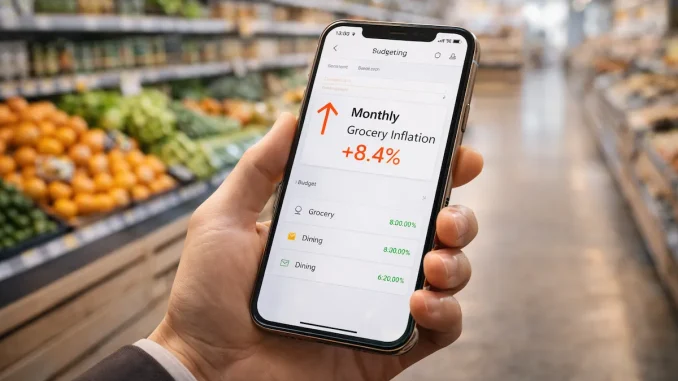
Inflation is the silent tax that no one votes for, yet everyone pays. It doesn’t just change the numbers on a price tag; it fundamentally alters how you must manage your money to maintain your quality of life.
In 2026, the global economy is grappling with “Sticky Inflation”—a state where prices remain elevated even after the initial economic shocks have passed. For the average individual, this means that a salary that felt comfortable two years ago may now feel restrictive. Understanding the mechanics of inflation is no longer a task for economists; it is a vital survival skill for every household.
Building on our discussion of emergency funds, inflation adds a layer of complexity: not only do you need a safety net, but that net must grow to keep pace with rising costs. In this guide, we will break down exactly how inflation erodes your “Real Income,” identify the hidden areas where it hits your wallet hardest, and provide actionable strategies to protect your purchasing power.
The “Purchasing Power” Erosion: Why $100 Isn’t $100 Anymore
Purchasing power is the amount of goods or services that one unit of currency can buy. When inflation rises, your purchasing power falls. This creates a Wealth Gap for those who keep their money in non-interest-bearing accounts.
📉 The 2026 Reality Check
If inflation averages 4% per year, the value of your cash is cut in half in approximately 18 years. If you are not earning at least 4% on your savings, you are mathematically losing wealth every single day, even if the balance in your bank account stays the same.
Lifestyle Creep vs. Inflationary Creep
Most people are familiar with “Lifestyle Creep” (spending more as you earn more). However, Inflationary Creep is more dangerous because it is involuntary. It forces you to spend more just to stay in the same place. Here is how it typically hits the three pillars of a household budget:
| Budget Category | Inflationary Impact | 2026 Defense Strategy |
|---|---|---|
| Shelter (Rent/Mortgage) | High (Lagging effect) | Lock in fixed-rate mortgages; negotiate long-term leases. |
| Food & Essentials | Volatile (Supply chain sensitive) | Bulk buying; switching to private-label brands. |
| Transportation/Energy | Immediate (Direct oil price link) | Optimization of travel; energy-efficient home upgrades. |
Protecting Your Savings: The “Real Return” Strategy
To fight inflation, you must focus on your Real Rate of Return. This is your nominal return minus the inflation rate. If your savings account pays 5% but inflation is 4%, your real return is only 1%.
💡 Pro-Tip: I-Bonds and TIPS
In 2026, Treasury Inflation-Protected Securities (TIPS) and Series I Savings Bonds have become essential for conservative investors. Their principal value adjusts with inflation, ensuring your “Real” purchasing power remains intact regardless of price surges.
[Image: A realistic photo of a professional desk with a laptop displaying a financial chart comparing the Consumer Price Index (CPI) with average wage growth.]
The “Shrinkflation” Trap: What to Watch For
Inflation isn’t always reflected in the price tag. Often, companies use Shrinkflation—reducing the size or quantity of a product while keeping the price the same. To combat this, smart consumers in 2026 are looking at the Price per Unit (e.g., price per gram or ounce) rather than the total package price.
Final Thoughts: Staying Ahead of the Curve
Inflation is a persistent force, but it is not one that you are powerless against. By understanding how it impacts your specific cost of living and adjusting your investment and spending habits accordingly, you can mitigate its effects. The goal is to ensure that your wealth grows faster than the cost of the world around you.
Protecting your purchasing power is a cornerstone of any solid plan. In our final article of this series, we will bring all these concepts together in financial planning basics everyone should understand, providing you with a complete roadmap for your financial future.
Frequently Asked Questions (FAQ)
Does inflation help people with debt?
Yes, in a specific way. If you have fixed-rate debt (like a 30-year mortgage), inflation can actually benefit you. As inflation rises, you are paying back the loan with currency that is worth less than when you borrowed it, effectively reducing the “Real” cost of your debt. However, this only works if your income also rises with inflation.
Which assets perform best during high inflation?
Historically, commodities (gold, oil, grain), real estate, and stocks of companies with high pricing power perform best. These assets have intrinsic value that tends to rise as the currency devalues. Physical assets, in particular, act as a natural hedge against the “money printing” that often drives inflation.
How often should I adjust my budget for inflation?
In the current 2026 economic environment, a quarterly audit is recommended. Check your last three months of spending on essentials like groceries and utilities. If you see a consistent upward trend of more than 5%, it’s time to re-allocate funds from your “Wants” category to maintain your savings goals.
Should I stop investing in bonds when inflation is high?
Not necessarily, but you should be selective. Traditional fixed-rate bonds lose value when inflation (and interest rates) rise. However, as we discussed, inflation-linked bonds are specifically designed for this environment and should remain a part of a diversified portfolio to reduce overall volatility.




Be the first to comment